1) Step 1- Problem or Opportunity Statement
As most of the point estimates in projects will become accurate in time, it is necessary to assess with certain frequency if risk or opportunities remain after accomplishing certain milestones or a certain period of time passed. By consequence, Contingency should be always assessed to determine if we still need more or less money for certain risk or opportunities identified and tactical or strategical responses will perform accordingly.
For Public Projects, Contingency is not allowed and based on the last post (W9_Piero_Anticona_Strategic/Tactical Response for Risk/Opportunities in Public Point Estimates), we can hide or create a buffer to add contingency in the point estimates.
For that reason, we also require to analyze which best practice suggest a good tracking tool or technique for the Buffer and Contingency alternative if we expect to meet Public Projects objectives.
For that reason, we also require to analyze which best practice suggest a good tracking tool or technique for the Buffer and Contingency alternative if we expect to meet Public Projects objectives.
What are best practices for Monitoring Risk that can help to implement the best tool or technique to track and control Contingency in Public Project Point Estimates?
2) Step 2 – Feasible Alternatives
Most common best practices are:
1. Project Management Body of Knowledge (PMBOK) from Project Management Institute
2. Total Cost Management Framework (TCM) from AACE International
We are going to add:
3. Compendium and Reference (CaR) from Guild of Project Controls
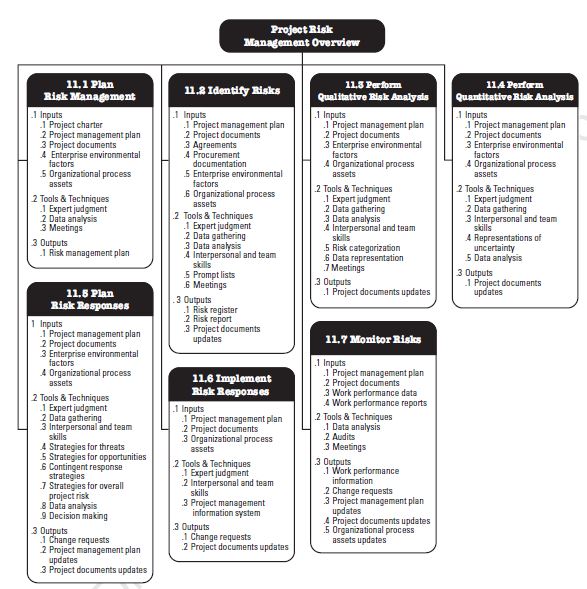
As seen in post W9_ Piero_Anticona_Strategic/Tactical Response for Risk/Opportunities in Public Point Estimates, the three of them offer Risk Management Process Maps. See maps below:
1. PMBOK – PMI
 |
| PMBOK Risk Management Process |
2. TCM – AACE International
 |
| TCM Risk Management Process |
3. Guild of Project Controls
 |
| Guild of Project Controls Risk Management Process |
3) Step 3- Develop the outcomes for each alternative
The following tools and techniques are part of the monitoring risk process in the three best practices mentioned before:
 |
| Tools and Techniques for Risk Control |
As we can see, TCM only suggests one tool for a similar process. If we look closer at its Risk Management Process, there is an Analysis of Contingency as an output of Risk Control Process that belongs to the Risk Assessment Process. Besides, it is part of the Risk Management Process, therefore we can consider this tool in this list because a similar tool is included in PMBOK. We can see a definition of the similar tool for both best practices:
 |
| Definition of Reserve Analysis and Analyze Contingency |
Let’s see the final list to be assessed:
 |
| Final List of Tools and Techniques for Risk Control |
For an effective analyze, we are going to merge those tools or techniques that are similar in two or three groups. The main reason is that as they are similar, results will be the same in both or three groups. So, it will not produce a differentiator between them which might not add value to the analysis. We can compare this merged tools against other tools.
Therefore, we only are going to analyze the following list:
1
|
PMBOK – Technical Performance Analysis
|
PMBOK- TPA
|
2
|
PMBOK/GPC – Analyze Reserve / Contingency
|
PMBOK/GPC – A R/C
|
3
|
PMBOK - Audits
|
PMBOK – Aud
|
4
|
PMBOK/GPC - Meetings
|
PMBOK/GPC – M
|
5
|
GPC – Statistical Process Control Chart
|
GPC – SPCC
|
6
|
GPC – Pareto Analysis
|
GPC – PA
|
7
|
GPC – Process Capability Analysis
|
GPC – PCA
|
8
|
GPC – Accuracy vs Precision vs Reliable Data
|
GPC – A/P/R
|
9
|
GPC – Contingency Draw Down Graphs
|
GPC - CDDG
|
4) Step 4- Selection of the acceptable criteria.
The following attributes will be considered for the selection criteria:
- Mandatory to Quantify impacts when event occcurs
- Mandatory to Create Tendency Charts
- Can analyze accuracy against baseline
- Can analyze precision against baseline
- Can analyze reliability against baseline
5) Step 5- Compare the outcomes from each alternative analysis done in Step 3 against the minimum acceptable criteria from Step 4.
Using Multiattribute Decision Making, we will analyze as follows:
Non Compensatory Models
1. Dominance
 |
| Dominance Matrix |
The Tools and Techniques that meet most the acceptable criteria are GPC - Accuracy vs Precision vs Reliable Data and GPC - Contingency Draw Down
2. Satisfacing
 |
| Satisfacing Analysis |
The Tools and Techniques that satisfy minimum acceptable criteria are GPC - Accuracy vs Precision vs Reliable Data and GPC - Contingency Draw Down. As the others do not meet minimum acceptable criteria, they can be discarded.
3. Lexicography
 |
| Lexicography Analysis |
Conclusion
GPC – A/P/R and GPC - CDDG meet acceptable criteria
Compensatory Models
1. Non Dimensional Escaling
 |
| Non Dimensional Analysis |
Conclusion
Best choices are GPC – A/P/R and GPC - CDDG
Best choices are GPC – A/P/R and GPC - CDDG
2. The additive weighting technique
 |
| The Additive Weighting Technique Analysis |
Conclusion
The best choices are GPC – A/P/R and GPC - CDDG
6) Step 6- Selection of the “best”.
One of the main reasons that we want to monitor Buffer or Buried Contingency is because we want to meet Point Estimates and avoid cost overruns. For that reason, the best choices that meet all of the attribute criteria are GPC – Accuracy, Precision and Reliability and GPC Contingency Draw Down Graphs in the previous step. 5 positive results out of 5.
With these tools it is possible to Manage Contingency also in Public Projects.
With these tools it is possible to Manage Contingency also in Public Projects.
7) Step 7- How to plan on tracking/reporting on the recommended choice.
Assuming that we are working on a Public Project and
contingency is hidden or in a buffer, based on author experience a good way to
determine if tools are supporting correctly Management Contingency is through
Change Management Process. A short list of Change Orders should be submitted or
a short list of Change Orders might be produced to request transfer budgets
between accounts.
----------
8) REFERENCES.
H. Lance Stephenson. (2015). Total cost management framework: An Integrated Approach to Portfolio, Program, and Project Management (2nd Ed.). Morgantown, WV: AACE International. Pages 206 - 209.
Guild of Project Controls. (2016, January 05). 04.6 risk_opportunity_monitoring_and_control-_rev1.00. Retrieved September 15, 2018, from http://www.planningplanet.com/guild/gpccar/risk_opportunity_responses_strategies_and_tactics
A Guide to the Project Management Body of Knowledge (PMBOK® Guide), 6th ed. Newton Square, Pa: Project Management Institute, Inc. 2017. Pages 453 - 458
Sullivan, W. G., Wicks, E. M., & Koelling, C. P. (2012). Decision making Considering Multiattributes. In Engineering Economy (15th ed.). Harlow, England: Pearson Education Limited.
Anticona, P. (2018, November 3). W8.1 Sensitivity Analysis and Contingency. Distance Learning Mode with PDG - 2018 / 2019 [Web log post]. Retrieved from https://pieroanticona-projectcontrol.blogspot.com
Anticona, P. (2018, November 9). W9_Piero_Anticona_Strategic/Tactical Response for Risk/Opportunities in Public Point Estimates. Distance Learning Mode with PDG - 2018 / 2019 [Web log post]. Retrieved from https://pieroanticona-projectcontrol.blogspot.com